Sheikh Zayed Book Award winner Hoda Barakat says new generation is reviving Arab literature
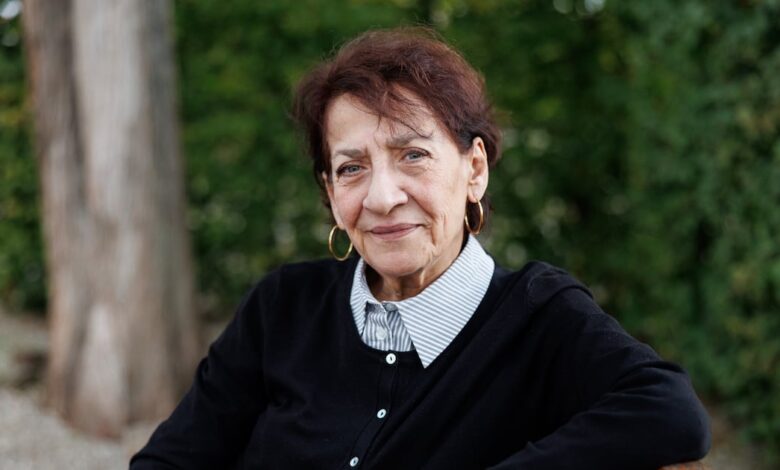
Hoda Barakat, the Lebanese author and winner of this year’s Sheikh Zayed Book Award for Literature, believes a new generation of authors and readers are bringing renewed attention and precision to the language.
“The new writers now know Arabic and don’t make many mistakes,” she tells The National at the Frankfurt International Book Fair. “That is different from the generation that came before, around the 1990s and 2000s, who I feel didn’t really consider the importance of mastering the Arabic language as a priority and a writer’s duty.
“This is happening now, and I see it also from the people who are reading my work. They are much younger and they are from Morocco to the UAE.”
A driver for that development, she says, lies in higher standards of education in the region and a growing sense of responsibility among writers to protect the language in the face of globalisation and social media.
Barakat says her responsibility extends beyond writing acclaimed novels to refusing to work with translators who have not mastered Arabic. She insists her books are translated directly from the original and not using a third language such as French or English.
Barakat acknowledges that her strict standards for translation may slow the process, but says precision matters more than speed.
“Our language is exposed to erosion and it is not only linguistic but cultural. I sometimes see translation shortcuts in certain books and the casual way Arabic is used online,” she says.
“As writers, we have to be guardians of the Arabic language, maintain our respect for it, before we give to the next generation.”
It is a principle put into practice in her award-winning novel Hind or the Most Beautiful Woman in the World. Published last year and included in The National‘s 50 most important Arabic novels of the 21st century, the book traces the experience of a woman living with acromegaly, a rare hormonal disorder that causes abnormal growth of the face and body, and the social pressures that come with beauty and difference.
“The novel speaks about the scales of beauty in people and in cities that have changed in people’s memory,” she says. “I tell the story of a girl born very beautiful after the death of her sister, who was also beautiful.
“She later becomes ill with acromegaly and her body begins to change. Through that transformation, she develops new sensitivities and new ways of perceiving the world.”
The work continues some of the broader themes of Barakat’s writing, with novels often tracing how trauma and displacement shape private lives.
The Night Mail, which won the 2019 International Prize for Arabic Fiction, follows a group on the margins of society who write letters they know will never be delivered. Through these voices, including migrants, exiles and the displaced, Barakat explores how distance shape the lives of those uprooted by war.
“I don’t write in a very classical way,” she says. “I don’t defend a cause. I invite people who read me to think with me, to question with me, to worry with me, to be happy or sad with me. But I’m not one of those writers who preach ideas. If I revived a little feeling or some questions, I would have done my job.”
Both Hind or the Most Beautiful Woman in the World and The Night Mail, with the latter available in English, carry Barakat’s signature style: a pared-back prose prioritising economy and emotional precision. She describes each book as an intimate process whose completion brings hard-won satisfaction.
“I write slowly and think a lot because I don’t want to repeat myself,” she says. “When the character becomes fixed in my mind, I can gauge whether the character has a story worth telling me.
“I view my writing as a continual process of refinement, expansion and purification. Doing it that way made me feel immersed, and at times I rediscovered the beauty of the Arabic language. I can teach in English and I also write in French, but the only literature I want to be involved in is Arabic.”
Barakat says the Arabic language carries a stigma abroad, and the arts can help free it from negative associations caused by factors far away from arts and culture.
She recalls a reading at an Italian literary festival two decades ago, where she explained the meanings behind the Arabic phrase “Allahu akbar” – “God is great” – to an audience who only knew it through fear.
“I explained how the phrase is essentially a cry of wisdom,” she says. “It means saying to the transgressor, the arrogant, the powerful: ‘Remember, there is one who is stronger.’ I say it to express delight or when I see something beautiful. It is not a war cry.
“The people in the audience were moved, and maybe it made them realise, even if fleetingly, how much propaganda controls people’s connection to each other.”
Exile has deepened that understanding. Born in Beirut and living in Paris after fleeing the Lebanese civil war in 1989, Barakat says the relative stability afforded by the French capital came with the burden of carrying her language abroad.
“Those who live abroad know to what degree this language is oppressed and was associated with intolerance,” she says. “We need writers and people far away from these things to keep working with the language and bringing it to the status it deserves.”
That work continues in Barakat’s regular masterclasses at Dartmouth College, the Ivy League university in the US.
She describes her students from fields such as physics and political science, drawn to Arabic novels for the first time. “They come not from those studying literature,” she says. “Among them are students discovering they love writing. They get to know Arab civilisation through novels.
“The classes may be small, but important things always start with a minority, and this new generation of students is part of a generation that will have a better understanding of the beauty and nuance of the language.”
That revival, she says, is already bearing fruit with the support and profile of the Sheikh Zayed Book Award.
“There is an awakening in the Arab world with major institutions that have begun to truly care about reviving the Arabic language with determination, will and a forward-looking sense,” she says.
“We cannot continue if our language does not envision the future. As someone who lives, breathes and works in the language, I tell you that it is alive and well, and we should keep it that way.”
Source link