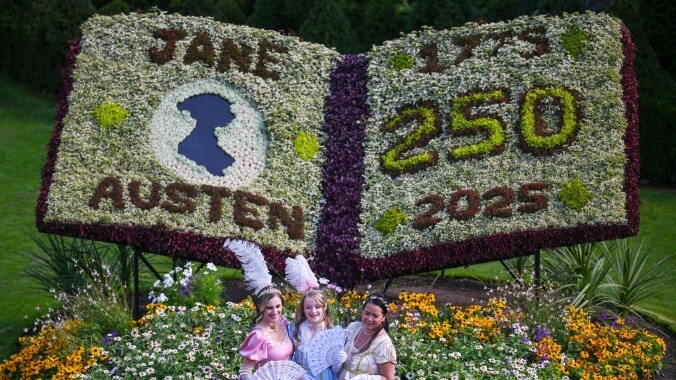
Jane Austen was born 250 years ago today, making her a few months older than American independence, 14 years older than the French Revolution, and 25 years older than the electric battery. Like many other English women of her era, she lived primarily in small towns in the countryside, and because she never married, she spent much of her time helping to care for her aging mother and doling out advice to her nieces. Yet unlike most of her peers, who have vanished into history, the 250th anniversary of Austen’s birth has been cause for celebration across the world. From her superficially quiet life in the English countryside, Austen wrote six novels that became, and have remained, among the most beloved works of English literature.
Throughout 2025, museums and literary societies across the world—but especially in the United Kingdom and United States—have held exhibits, balls, festivals, and talks in honor of one of the world’s best-loved authors. This past weekend the Jane Austen Festival (an annual event) held a special Yuletide Birthday Ball in her honor in Bath, England, for which Regency dress was mandatory, warning attendees that “NO HIGH HEELS ARE PERMITTED IN THE VENUE.” (Not period accurate!)
Part of Austen’s longevity must be put down to luck. As writer and rare book dealer Rebecca Romney explains in her illuminating book Jane Austen’s Bookshelf, for a long time, (white, male) scholars of literature insisted that Austen was “the first great woman writer in English,” when they in fact mean that she was “the first British woman accepted into the Western canon.” Making Austen the “first” has diminished the accomplishments of her predecessors and peers, including writers like Frances Burney and Maria Edgeworth whose work she read and loved. Their novels, like Austen’s, are witty, insightful about the societal conventions that dictated women’s lives at the time, and often feature romance plots.
But Austen’s books are special. Few canonical texts offer readers the pleasure of escapism, but Austen’s romance plots and the pleasure of her humor have made Regency England a site of fantasy for many of her readers (as the success of Bridgerton has demonstrated). It would be reductive, though, to label Austen “just” a romance novelist, even if the romances in her novels are undeniably part of their allure. She wasn’t always viewed as the queen of romance, for one thing: In her recent book Jane Austen in 41 Objects, Austen scholar Kathryn Sutherland describes a BBC program celebrating Austen’s bicentennial in 1975, in which a group of critics discussed Austen as “a deeply serious, moral writer.” Her reputation shifted dramatically in 1995, when the BBC released its now-famous Pride & Prejudice miniseries; Sense & Sensibility and Clueless came out the same year. Suddenly, Austen was no longer a moral instructor but a writer of romance and a pop culture icon.
Austen’s longevity can’t be ascribed to only one aspect of her books, because the books themselves are so protean. They’re flexible enough to have remained popular across wildly different historical moments, when readers have wanted different things out of the books they read. Austen can be a moral guide, or a romance novelist, or a writer carefully observing how limiting life was for women in Regency England. Because her books contain so much, they have remained gripping no matter how much time has passed, even as other forms of entertainment have come to consume so much of our attention. As writer Jennifer Egan, who wrote the introduction for a new edition of Emma, told Jezebel, “That her work is so accessible, that a hot genre right now [romance] claims her as their founding member, and that she was born that long ago, is just a reminder for me of how relevant and necessary literary expression is, even in our completely screen-deluged times.”
Thanks to the onslaught of Austen adaptations over the last three decades, most readers of her work have a decent idea of how people dressed in Regency England. But, as Egan pointed out, Austen’s books themselves are short on descriptions of her characters, their clothes, and their surroundings. Though readers may have a vivid image of beloved heroine Elizabeth Bennet in their heads, that image doesn’t come from Austen. Critic John Mullan writes that Austen skimps on description because she “wants us to think not so much about how characters look, but how they look to each other.”
Egan argues that this may be part of the reason that Austen’s work has endured and remained accessible to readers today. Because they focus on relationships, she said, Austen’s books continue to feel relevant to us: “The rules around female behavior have changed, but the architecture of how people interact and fall in love have not. These are timeless and universal relationships. And the fact that there isn’t a lot of atmospheric detail may help contemporary readers.” Critics at the time realized there was something special about Austen’s psychological acuity, and her rendering of emotions, too: One contemporary critic described her writing as rendering “naked a female mind.”
This is all another way of saying that Austen’s writing is more concerned with emotional content than visual detail, or other elements that make books by her peers less accessible to readers today. Writers like Burney and Edgeworth make plenty of cultural and political references that their first readers would have found funny or thought-provoking, just like many novelists do today, but those references now require explanation. Austen was hardly divorced from her time and place—her books are full of references to the Napoleonic Wars, for example—but they are sparer than those of her contemporaries.
Instead, Austen often focuses on money, a matter of great importance for women worrying about their futures on the marriage market: Because genteel women couldn’t work themselves, it was crucial that their husbands be able to support them. As annoying as Mrs. Bennet’s fixation on eligible bachelors may be, she knows very well how important it is for her daughters to marry successfully. When she asks Mr. Bennet to take seriously the task of charming Mr. Bingley, and “consider your daughters,” she isn’t in the wrong.
When Austen introduces her characters, she is in fact more likely to focus on their financial status than their physical appearance. At the ball where Elizabeth first encounters Darcy, for example, he attracts attention thanks to his “fine, tall person, handsome features, noble mien; and the report which was in general circulation within five minutes after his entrance, of his having ten thousand a-year.” Although she does tell us that Darcy is tall, his money is clearly more important to the local women speculating about his marriage prospects than his appearance. And for all her stubbornness, even our cherished Elizabeth is not immune to the allure of financial comfort: Later in the novel, Elizabeth will admit that she first truly began to fall in love with Darcy “from my first seeing his beautiful grounds at Pemberley.”
Austen herself depended on the largesse of male relatives to provide her and her other single female relatives with a place to live. Although she mostly lived in comfortable circumstances, her household relied on a donkey cart, rather than a full carriage; and when she was dying in her early 40s, Austen arranged her body over some chairs so that her elderly mother could lie on their cottage’s only sofa. Characters in similar positions are sprinkled through her novels, most notably the pitiable Miss Bates in Emma.
While Miss Bates knows that her fate is sealed and that she will never marry, Austen’s heroines have to reckon with the possibility of marriage versus the struggles of living as a single woman. (The wealthy Emma, who initially declares she will never marry because of her fortune, is an exception.) For women at this time, marriage was not only complicated because of monetary concerns, but also due to more existential worries. When a woman married in Austen’s era, she gave up her rights as an individual, forfeiting her property and her legal identity to her husband. Scholar Zoë McGee, whose new book Courting Disaster explores consent in the literature of the period, explained that, “The question of what your husband is legally able to do to you, and what your life is going to be like, is really scary. However nice they might be, it’s a horrible, terrifying thought.”
The decision of who a woman chose to marry was, then, the most important decision she would make in her life, and so it’s hardly surprising that Austen’s novels revolve around this choice (and that her secondary characters have such strong feelings on the matter). When Elizabeth Bennet refuses to marry the bloviating Mr. Collins, her mother rages: “I tell you what, Miss Lizzy – if you take it into your head to go on refusing every offer of marriage in this way, you will never get a husband at all – and I am sure I do not know who is to maintain you when your father is dead.” Mrs. Bennet is manipulative and unfeeling, but she is not wrong that Lizzy’s life could easily go wrong in the future as a result of this decision. Elizabeth is attractive and charming, but most men with money sought women who also had money; Lizzy has none. Fanny Price of Mansfield Park suffers more when her uncle Sir Thomas Bertram discovers that she’s rejected a proposal from Henry Crawford, a superficially respectable man whom Fanny distrusts and certainly doesn’t love: With “calm displeasure,” he tells her, “you do not know your own mind.”
In reality, most women in a position like Fanny’s would probably wind up giving into this kind of bullying and marrying men they didn’t want to. But Fanny and Lizzy are characters in novels, and Austen imbues them with a greater freedom of choice. Given that Fanny’s financial position is even more precarious than Elizabeth’s, both these decisions reflect a fierce moral commitment to marrying only a man the heroine can love and respect, even when risking future impoverishment. Both, of course, wind up marrying the men they love, but there are real stakes underpinning these books, reminding the reader that in this period, that was hardly always the case.
The fact that these characters do get to fall in love and marry happily is, on some level, a romantic fantasy, but as McGee argued, it’s not one entirely divorced from reality. “I don’t think [the heroes] are Prince Charming,” she said. Instead, the relationships “feel like an achievable, good situation. The romance is compelling because there is a version of this [relationship] that is happy. A lot of Austen’s heroes are quiet, they listen, they respect their partners’ opinions, they take on board what she says, and a lot of them change or modify their opinions.” Those changes may be subtle, but they come as a result of their interactions with the heroines. While these men may have more power in the outside world, in the inner world of Austen’s novels, men and women exist on equal footing.
As McGee put it, Austen tells her readers, “You can dream of a partnership that has equality and respect.” In the early 19th century, this was a radical proposition, and it’s this dream that keeps her novels vivid and alive for readers in 2025. Anyone who wants a partner, no matter their gender or sexuality, dreams of being in a relationship based on equality and respect. And even though women have far more legal rights now than they did in 1775, inequalities persist between men and women in heterosexual relationships, whether that be in housework, childcare, or a simple failure of respect. Austen teaches readers not to settle for someone who doesn’t recognize them as a full person, no matter their situation. This message, coming from an author born a quarter millennium ago, is as enduring as her books.
Like what you just read? You’ve got great taste. Subscribe to Jezebel, and for $5 a month or $50 a year, you’ll get access to a bunch of subscriber benefits, including getting to read the next article (and all the ones after that) ad-free. Plus, you’ll be supporting independent journalism—which, can you even imagine not supporting independent journalism in times like these? Yikes.
Source link