
How Margaret Atwood’s memoir changes the way we see her books
Listen to this article
Estimated 5 minutes
The audio version of this article is generated by text-to-speech, a technology based on artificial intelligence.
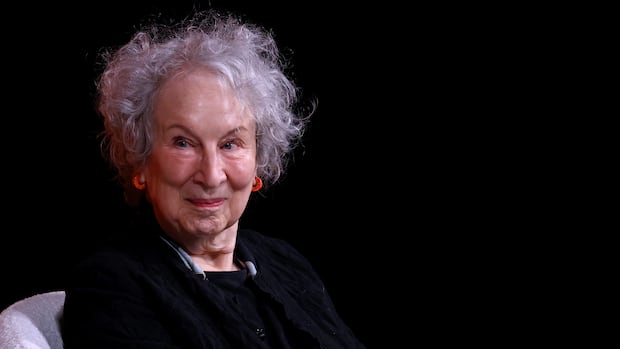
In the week since its release, much has been said about Margaret Atwood’s Book of Lives: A Memoir of Sorts.
The famous Canadian author revealed a lot about her life in the memoir, including her love of palmistry and the start of her relationship with her late partner Graeme Gibson. She also explains how she used her own life as inspiration to write novels such as The Handmaid’s Tale and Life Before Man.
Today on Commotion, host Elamin Abdelmahmoud investigates how Book of Lives changes how we read Atwood’s work with authors Heather O’Neill and Deborah Dundas.
We’ve included some highlights below, edited for length and clarity. For the full discussion, listen and follow Commotion with Elamin Abdelmahmoud on your favourite podcast player.
WATCH | Today’s episode on YouTube:
Elamin: Heather, not only have you read the memoir, as you were reading the memoir, you also found yourself re-reading three different novels of hers as you’re doing this. Tell me about the three books that you returned to.
Heather: I didn’t actually want to be re-reading Margaret Atwood’s novels at this particular time. As I was reading her memoir, I couldn’t stop myself. And then each time I was like, “Oh, I have to grab this book.” And I was, like, “Heather, you have things to do. You don’t have the entire November to re-read all of Margaret Atwood’s oeuvre.”
It’s a very gossipy part of the memoir where she talks about how she met Graeme Gibson and how he was in an open marriage, and immediately I was like, “Oh, open marriages” because I’ve been listening to Lily Allen on repeat…. She begins a relationship with Graeme Gibson, who’s in this open marriage and she wants it to be something more. She wants to have a relationship. She wants him to be the love of her life. So eventually they do end up living together, but Graeme Gibson always refuses to divorce his wife. Until Margaret gets pregnant, and then Graeme Gibson’s ex-wife divorces him. And even after that, Graeme Gibson refuses to then marry Margaret Atwood…. She almost villainizes his ex-wife for continuing to just wreak havoc on her life forever. And then I was like, “I have to go back to Life [Before] Man,” which was the novel she wrote about it at the time. And I was, like, “Girl, let me see what you said about it in the ’70s.”
Then in the memoir, she starts writing The Handmaid’s Tale…. Looking at it not only in the context of all the political things, but just in that dynamic of June the adulterer. And then I was thinking, in that bizarre ritual in Handmaid’s Tale — which I never knew what to make of it, why she chose to have the three of them having to have this sex together. And I was like, “Oh my God, Graeme Gibson obviously triangulated Margaret Atwood and [Shirley] Gibson in real life, and now they’re literally in a triangle.” And then…the commander’s wife is feeling so much grief, and there’s this younger woman who’s going to be pregnant and once she’s pregnant, that ended the marriage. If you read it just having read about this affair, it is very much in that book on the human dynamic.
Elamin: Deborah, I didn’t do that level of extent of what Heather did in terms of being like, “Oh, this is showing up here, this showing up here, this is showing up up here.” But did reading this memoir change the way that you read any of Margaret’s novels?
Deborah: The thing that stuck with me was Margaret Atwood talking in her memoir about saving elastics and every little thing, every little twist tie and things like that. And that comes from the Depression and growing up poor. You saved everything, you didn’t throw anything out just in case you needed it. And I remember from The Handmaid’s Tale — and I remember clocking it the first time I read it — was the plastic bags tumbling out from under the sink, where everybody, when we still used plastic bags, had them, plastic bags tumbling everywhere. My father, he was born about the same time she was, he had like three drawers in his kitchen full of plastic bags because he couldn’t get rid of them, but he didn’t need them. So this spoke to me of how every little detail of Atwood’s life becomes the details in the book.
I think she spoke to someone and said, “Everything in my fiction is true, all the details are true.” And when she’s writing her memoir, that’s how she sets it up, right? So she writes the memoir not in chronological order. So you get her childhood, but then she does it by book. So she doesn’t do a literary memoir per se where she talks about the book, she talks about what her life is — “Oh, and I happened to write this book during this time” — and she draws little connections to the books.
You can listen to the full discussion from today’s show on CBC Listen or on our podcast, Commotion with Elamin Abdelmahmoud, available wherever you get your podcasts.
Panel produced by Jessica Low.


